Monthly Archives: October 2018

Wisconsin FOIC marks 40 years of protecting openness

The Wisconsin Freedom of Information Council held an event Tuesday at the State Capitol to celebrate its 40th anniversary.

The Council and its supporters gathered in the Assembly Parlor to hear about the beginnings of the Council and the many efforts it has taken over the years to promote openness in government and protect the public from efforts to restrict access.

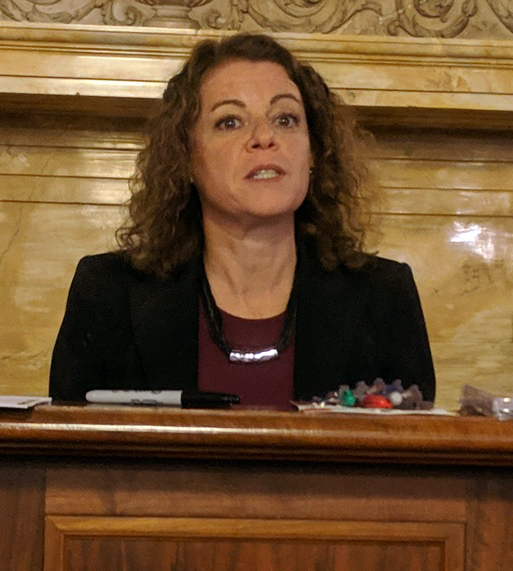
Wisconsin Supreme Court Justice Rebecca Dallet spoke at the event and discussed court transparency and efforts to increase trust in the court system.

State Supreme Court Justice Rebecca Dallet

State Supreme Court Justice Rebecca Dallet

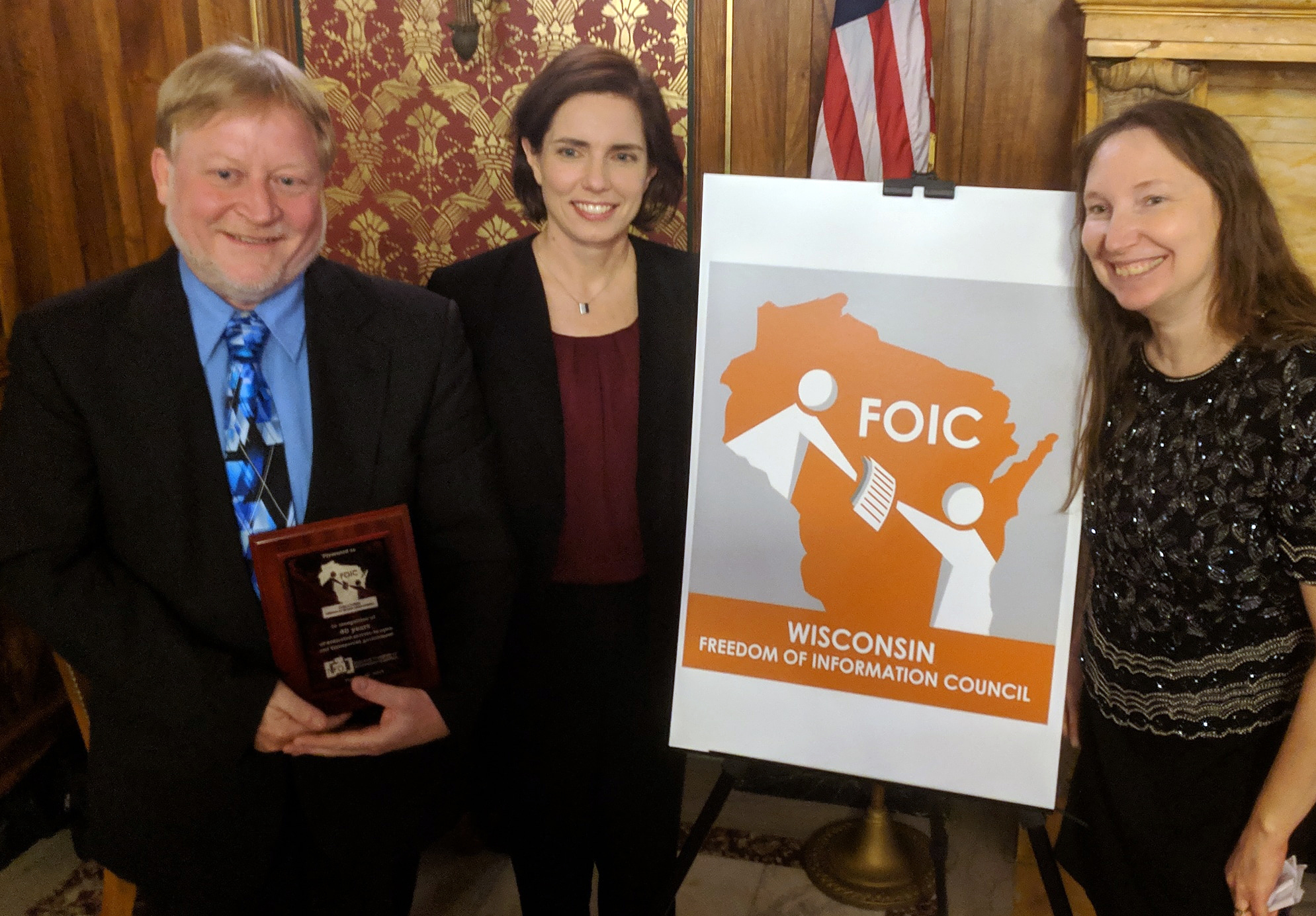
A new Wisconsin FOIC logo was unveiled:

FOIC President Bill Lueders and Co-Vice Presidents Christa Westerberg and April Barker

FOIC President Bill Lueders and Co-Vice Presidents Christa Westerberg and April Barker

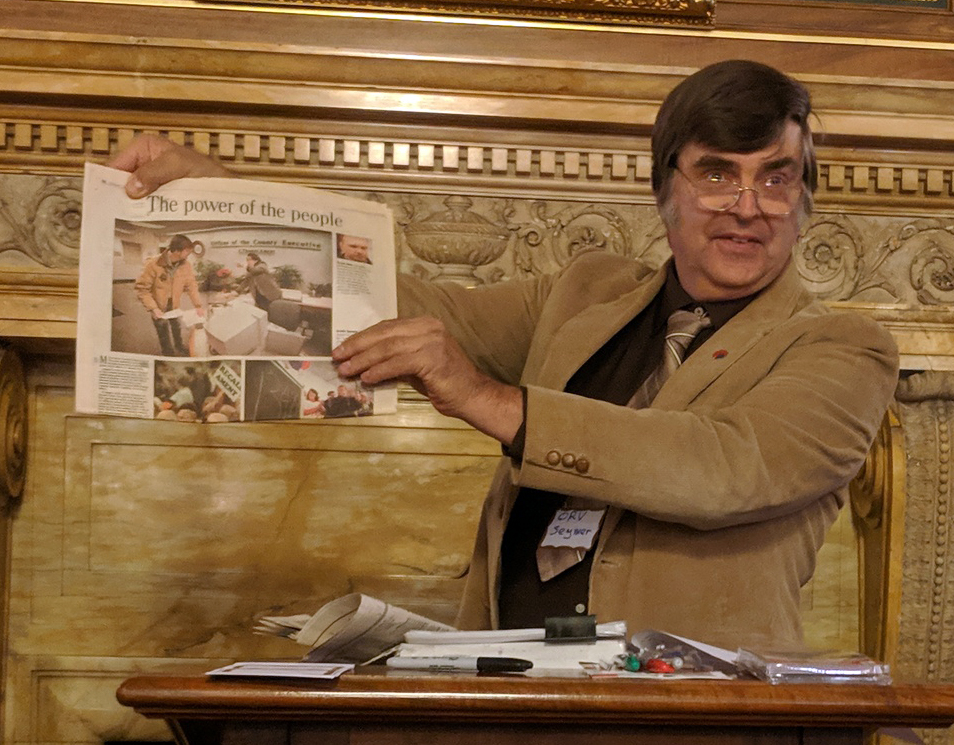
FOIC President Bill Lueders spoke at the event saying that he was proud of the Council’s non-partisan work. He pointed out that there are members of the Council with different political viewpoints but that they all work toward the common cause of maximizing openness in government.

Members of the FOIC include the Wisconsin Broadcasters Association, the Wisconsin Newspaper Association, and the Society of Professional Journalists.


Brooks leaving WTMJ-AM for San Francisco

Eric Brooks

WTMJ-AM Director of Programming and News Eric Brooks is leaving Milwaukee for San Francisco.

Brooks will be Assistant News Director at News Radio KCBS San Francisco.

Brooks was at WTMJ for eight years and is credited with making countless contributions to the station. Most recently, he designed and oversaw the station’s coverage during the Brewers playoff run.

His last day at WTMJ is Oct. 31.

Watch panel discussion about threats against broadcasters

A panel discussion at the Broadcasters Clinic talked about the safety of broadcasters and journalists in light of new threats.

The panel discussion titled “Personal Safety in Today’s Broadcasting Environment” was led by WLUK-TV News Director and WBA Board member Juli Buehler. The panel included RTDNA Executive Director Dan Shelley, Quincy Media Regional Vice President Tom Allen, WORT-FM Board President David Devereaux-Weber, attorney David Oxenford, and Madison Police Chief Mike Koval.

The panel discussion is now available to watch here:

Keeping broadcasters and journalists safe from Wisconsin Broadcasters Assn on Vimeo.

The panelists talked about recent incidents of violence in broadcast facilities and against journalists, including a recent shooting at WORT-FM, a community radio station in Madison. The panel discussed ways that engineers and managers can work to plan for crisis situations and train employees to react appropriately.

Shelley spoke to the new threats facing journalists. Chief Koval talked about what stations can expect from police departments when planning for a shooting or reacting to one. Devereaux-Weber talked about the shooting at WORT-FM and how it’s changed how he views security at his station. Oxenford discussed the liability concerns being raised by employers facing the threat of workplace violence.

The panel agreed that broadcasters should be planning for the possibility of workplace violence and taking all threats seriously.

Celebration marks 40 years of advocating for openness

The Wisconsin Freedom of Information Council is celebrating 40 years of advocating for openness in government with a celebration at the State Capitol next Tuesday.

The celebration is scheduled for 3 p.m. at the Assembly Parlor in the Wisconsin State Capitol. The event will feature speakers and the unveiling of open government artwork and the Wisconsin FOIC’s new logo.

The Isthmus wrote an article this week about the anniversary and current state of openness in Wisconsin government.

The WBA is a proud member of the Wisconsin FOIC.

Open letter to journalists following Wednesday’s terrorist incidents

The following open letter from RTDNA Executive Director Dan Shelley was published Wednesday afternoon.

Terrorist incidents such as those that have targeted CNN’s offices in New York City, current and former public officials, and political activists are inexcusable, reprehensible and, unfortunately, frightening.

Now more than ever, we – the men and women who work hard every single day to fulfill your constitutionally-guaranteed duty to seek and report the truth – must once again double down on responsible journalism.

We must also double down on security measures at our physical facilities and ensure our safety while we work in the field.

I don’t need to tell you that we live in a political and ideological era that has become far more than acerbic; much more than toxic. It is now dangerous.

A deranged individual or individuals, perhaps inspired by the rhetoric of current high-ranking candidates and public officials, are acting out against journalists in ways more harshly and cruelly than at any time in our nation’s modern history.

According to the U.S. Press Freedom Tracker, the archive of record for threats to journalists in America, at least 39 reporters and photojournalists have been physically attacked across the country so far this year.

The delivery of explosive devices to CNN and to high-profile people involved in the current political discourse are a blatant attempt to target an institution and citizens in order to intimidate them and provoke fear.

If we as journalists cave to that fear, then those responsible have won.

Speaking today at the White House, President Trump said:

“In these times we have to unify. We have to come together and send one clear, strong, unmistakable message that acts or threats of political violence of any kind have no place in the United States of America. This egregious conduct is abhorrent to everything we hold dear and sacred as Americans.”

Those words were uttered by the same person who has used harsh rhetoric targeting journalists and political opponents during campaign rallies in an extremely tense and divisive political environment.

It is the responsibility of RTDNA, the world’s largest professional association devoted exclusively to broadcast and digital journalism, to call out the president and those of his supporters who engage in such pomposity aimed at further dividing our country and inflaming hateful ideologies. We must do so even while acknowledging there is currently no indication that whoever is responsible for sending the explosive devices has been inspired in some demented way by words spoken at a political rally or in a campaign ad.

It is the responsibility of the journalists of America to keep their heads down and continue to the important work to which they were called.

Don’t succumb to intimidation and fear.

Watch your backs, but don’t back down.

NAB releases toolkit for reporting on religion

The National Association of Broadcasters (NAB) and the NAB Education Foundation this week released its new Reporting on Religion toolkit.

The website provides guidelines and recommendations for local radio and television station newsrooms, as well as journalism students, for covering religion and/or faith-based stories and issues. The online line toolkit contains good, credible, practical content and is user-friendly for newsrooms.

The resources can be found here: http://www.awarenessinreporting.org.


Journalists host post-election discussion in Madison

The Madison chapter of the Society of Professional Journalists is partnering with UW-Madison’s Center for Journalism Ethics to host a panel discussion Nov. 7 on journalism ethics and the challenges of covering politics in highly polarized times.

The event — which is free and open to the public — will be held in the Promenade Room at the Overture Center for the Arts from 6:30 to 8 p.m.

Scheduled for the day after the midterm elections, the event is bringing together panelists with expertise in media, political reporting and the news industry for a lively discussion on topics ranging from declining media trust, changing business models and social media to how partisanship affects both journalists and news consumers.

The three panelists are: David Folkenflik, the New York City-based media correspondent for NPR News and the host and editor of On Point from NPR and WBUR; Jessie Opoien, a reporter at the Capital Times covering state government and politics; and Dhavan Shah, the Maier-Bascom Professor in UW-Madison’s School of Journalism and Mass Communication and director of the Mass Communication Research Center.

Folkenflik will be visiting the Center for Journalism Ethics the week of Nov. 5 as part of the Center’s journalist in residence program, an initiative now in its third year.

The event will be moderated by Center Director Kathleen Bartzen Culver, who’s also the James E. Burgess Chair in Journalism Ethics.

Candidates debate questions from broadcast journalists

The WBA Foundation hosted two political debates in the last week to give voters more information about candidates on the ballot in two important statewide races.

In Wausau, Sen. Tammy Baldwin and Leah Vukmir took questions from Holly Chilsen, WSAW-TV; Ben Meyer, WJFW-TV; Chris Conley, WSAU, Melissa Langbehn, WAOW-TV, and Jeff Thelen, WSAW-TV.

In Madison, Gov. Scott Walker and Tony Evers took questions from Jessica Arp, WISC-TV; Emilee Fannon, WKOW-TV; Lupita Montoto, La Movida Radio; and Leigh Mills, WMTV-TV.

Thank you to these hard working journalists who put hours into preparing for these debates.

Both debates aired on more than 80 radio and TV stations throughout Wisconsin, and some may rebroadcast it before the Nov. 6 election. Check your local listings. The debates will also soon be posted to the WBA Museum website.


FOIC Survey: Dems back more openness, GOP mostly mum

Dee Hall

Editor’s Note: This is a column from the Wisconsin Freedom of Information Council.

In advance of the Nov. 6 elections, the Wisconsin Freedom of Information Council surveyed candidates for state Assembly and Senate to gauge support for initiatives to require more openness by public officials, including the Legislature.

We sent surveys to 204 candidates: 106 Democrats, 84 Republicans and 14 third-party contenders. We received 75 responses from 60 Democrats, eight Republicans and seven third-party candidates, for a 37 percent response rate.

Most of the Democrats who responded offered conditional support for many of the ideas.

One question concerned whether the candidate would support a change in the law to make legislators “subject to the same retention rules as all other state and local government officials.” Currently they are exempt. All 60 Democrats joined six Republicans and all seven third-party candidates in answering yes. Two Republicans answered no.

“While I am generally strongly supportive of the concept of increased transparency for governmental entities, including the Legislature, I would need to review the specific proposal before committing to a firm position on this issue,” wrote Assembly Minority Leader Gordon Hintz, D-Oshkosh, in an answer that was remarkably similar to that of several other Assembly Democratic candidates and incumbents.

All but three Democratic respondents also said that records requested in electronic form, when they exist as such, should be provided in electronic form, as did all eight Republicans.

Fifty-eight Democrats, two Republicans and seven third-party contenders favored legislation to require public bodies that go into closed session to make a recording of what is said; this would then be available for judicial review if the legality of the decision to go into closed session is challenged. Two Democrats and six Republicans were opposed.

“This will defeat the purpose of closed sessions,” wrote District 3 Assembly incumbent Rep. Ron Tusler, R-Harrison. His opponent, Democrat Scott Gavin of Little Chute, took the opposite view: “This is a necessary safeguard and insurance policy for situations where the decision to go into closed session was wrong.”

Democrats also overwhelmingly favored changes to the law to make the Legislature expressly subject to the Open Meetings Law, after a 2011 Supreme Court ruling raised ambiguity on this score. Republicans and Democrats alike favored requiring that all bills, amendments and motions have an identified sponsor.

Mechanisms such as the “999” omnibus motion allow lawmakers to insert last-minute, controversial measures into the state budget anonymously, with no public input.

“If you’re going to introduce legislation, stand behind it,” wrote Democrat Joe Lavernz of Fond du Lac. His Republican opponent, District 53 Assembly incumbent Rep. Michael Schraa of Oshkosh, was the only candidate who opposed this change, saying he introduced a bill last session under a committee name “so that one person wasn’t able to take all the credit.”

The question that drew the most dissention among Democrats was whether to end the the ability of legislators to meet as a caucus in secret. Forty-four Democratic respondents said yes, 16 said no. Among the eight Republicans who replied, the split was two in favor and six against.

“I think legislators should always be as transparent as possible, but I would like to learn more about when private meetings may be needed to help develop policy,” wrote District 17 Senate candidate Kriss Marion, a Democrat from Blanchardville, explaining her tentative “no” vote. Her opponent, incumbent Sen. Howard Marklein, R-Spring Green, did not respond to the survey.

For complete survey results, go to the FOIC website, wisfoic.org/candidate-survey-2018.

Your Right to Know is a monthly column distributed by the Wisconsin Freedom of Information Council (www.wisfoic.org), a group dedicated to open government. Dee J. Hall is the council’s secretary and managing editor of the Wisconsin Center for Investigative Journalism.

Preparations underway for WBA gubernatorial debate

The panelists for the WBA Foundation’s gubernatorial debate on Friday night are meeting Thursday to finish preparing questions for the candidates, Gov. Scott Walker and State Superintendent Tony Evers.

The debate will be held at WMTV-TV in Madison. WBA Hall of Famer Jill Geisler is moderating the debate and the panelists include: Jessica Arp, WISC-TV; Emiliee Fannon, WKOW-TV, Leigh Mills, WMTV-TV; and Lupita Montoto, La Movida radio.

The debate will air at 8 p.m. More than 80 radio and TV stations will carry the debate live or delayed. Find the full list here.